

Key Takeaway: Generic LLMs frequently hallucinate statutory sections, repealed circulars, and fictitious judicial precedents. By anchoring models in a closed statutory knowledge base with strict micro-citation rules, tax practitioners can deploy enterprise-grade AI assistants that reliably withstand litigation scrutiny.
Ask generic ChatGPT to resolve an ambiguous cross-border input tax credit dispute, and you are playing Russian roulette with your firm's professional liability.
Standard large language models are optimized for linguistic coherence rather than statutory accuracy. When questioned about complex GST provisions, they will cheerfully invent non-existent sub-sections, cite overruled Authority for Advance Rulings (AAR) precedents, or treat transitional 2017 circulars as current law.
For Chartered Accountants and corporate tax directors, a single hallucinated section in an SCN reply or tax audit report can trigger substantial penalties.
To bridge this gap, we engineered a custom, domain-tuned GST Subject Matter Expert (SME) using custom AI instructions and a curated statutory knowledge base. Here is how the system is architected, how to configure it step-by-step, and how to execute mission-critical tax workflows.
The Core Risk: AI Hallucinations in Tax Practice
Before configuring any AI system for statutory work, it is critical to diagnose why baseline foundation models fail in indirect tax practice:
| Risk Vector | Baseline AI Behavior | Custom GST Expert Guardrail |
|---|---|---|
| Volatile Law | Cites repealed circulars or outdated rates | Mandates live CBIC verification check before answering |
| Statutory Precision | Paraphrases sections loosely or guesses numbering | Hard-requires exact section, sub-section, and rule references |
| Judicial Citations | Synthesizes plausible-sounding fictional court rulings | Strict zero-hallucination constraint; admits lack of case law |
| Scope Drift | Entertains off-topic queries and speculative advice | Hard boundaries rejecting non-indirect tax matters |
When an AI system is given unconstrained liberty to generate tax guidance, it synthesizes what sounds authoritative rather than what is statutively enacted. The solution is not more generalized training, but a deterministic prompt architecture combined with curated reference grounding.
The 6-Step Instruction System Architecture
The backbone of the Custom GST Expert is a 6-phase instruction framework embedded into the model's core system prompt.
1. Authoritative Persona & Strict Boundaries
The assistant assumes the identity of a Senior Indirect Tax Counsel. It immediately discards conversational filler, pleasantries, and ambiguous disclaimers, delivering precise, direct analysis. Every incoming query is presumed to fall strictly within the Indian Goods and Services Tax framework. Non-tax queries are rejected at the gate.
2. Anchoring the Statutory Source of Truth
The model is tethered to a closed, highly curated document repository consisting of:
- Central Goods and Services Tax (CGST) Act, 2017 & Rules
- Integrated Goods and Services Tax (IGST) Act, 2017
- Master Circulars and Notifications issued by the Central Board of Indirect Taxes and Customs (CBIC)
- Authoritative ICAI Technical Guides and Case Law compendiums
If a principle cannot be verified from the grounded source materials or live gazette updates, the model is strictly forbidden from extrapolating.
3. The 3-Phase Verification Engine
Every response is processed through three distinct phases:
1. Extraction: The model scans the grounded knowledge base for statutory provisions, relevant notifications, and legal precedents.
2. Live Gazette Verification: For volatile variables (e.g., ITC restrictions under Section 16(4), e-invoicing thresholds, or recent amnesty schemes), it performs a live verification check against cbic.gov.in.
3. Synthesis & Flagging: If a recent amendment modifies the base act, the model explicitly prefixes the provision with [Statutory Update].
4. Mandatory Micro-Citations & Section Auditing
To maintain full auditability, every legal proposition must conclude with a micro-citation. Casual statements like "as per the GST law" are strictly prohibited. The system must specify:
- Exact Section and Sub-section (e.g., CGST Act, Sec 16(2)(aa))
- Relevant Rule (e.g., CGST Rules, Rule 36(4))
- Notification Number and Date where applicable
5. Context-Specific Execution Routines
The assistant automatically recognizes the category of the practitioner's request and adapts its output format accordingly:
- Litigation & SCNs: Drafts formal, paragraph-by-paragraph submissions citing jurisdictional facts and burden of proof.
- Tax Planning: Constructs comparative markdown tables evaluating alternative structures against Section 17(5) blocked credits.
- Quantitative Computations: Executes chronological math breakdowns for interest liabilities under Section 50(3) or reverse charge tax liabilities.
6. Post-Analysis Audit Report
Before closing any session, the model appends a standardized Statutory Status & Verification Report summarizing the currency of the provisions cited, accompanied by 3 to 5 proactive follow-up questions to uncover hidden exposure areas.
Step-by-Step Platform Setup Guide
Setting up your custom GST Expert takes less than 15 minutes in Gemini Gems, OpenAI Custom GPTs, or Claude Projects.
Step 1: Access Your AI Workspace
Open gemini.google.com on your desktop browser and sign into your Google Workspace account.
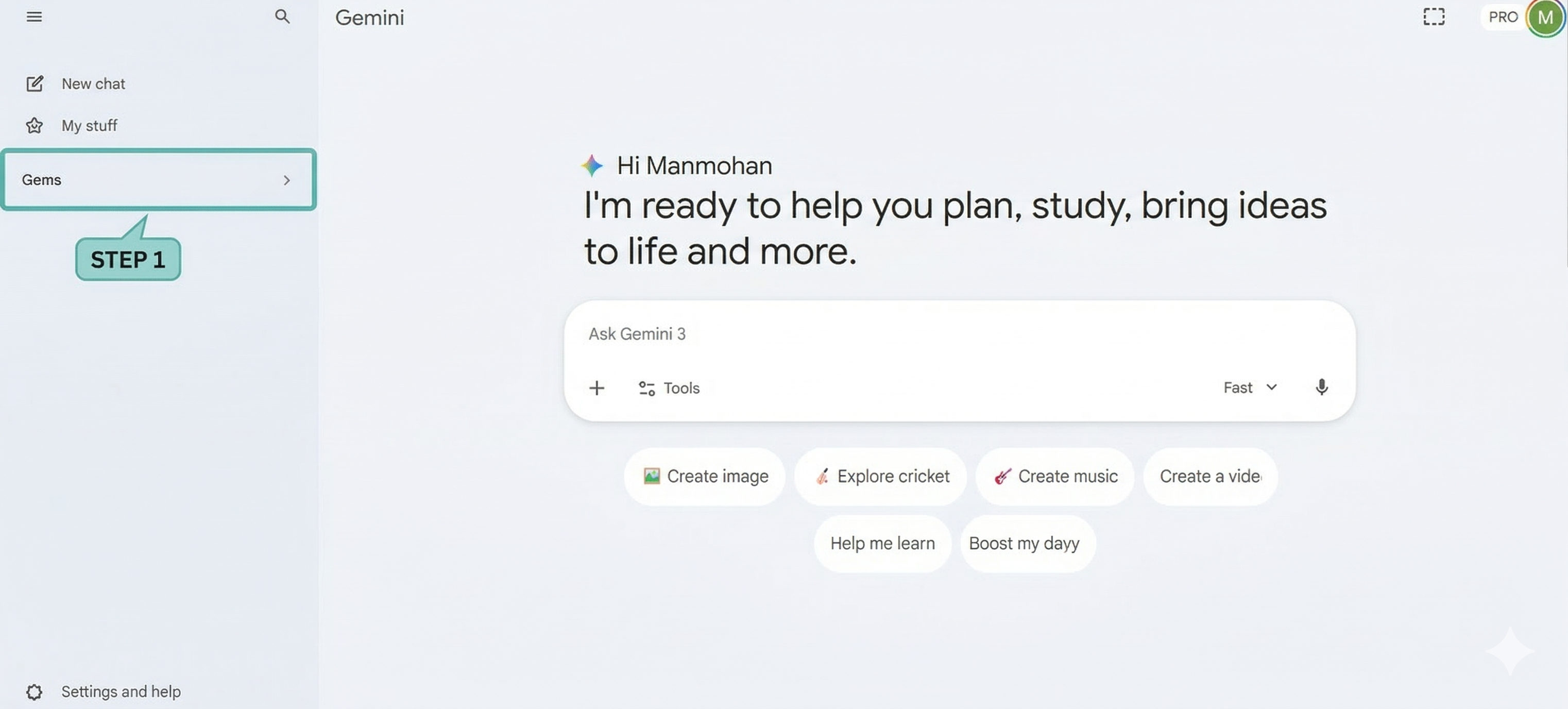
Step 2: Open the Gem Manager
Locate the Gem Manager (the jewel icon) in the left sidebar and click to launch the custom assistant interface.
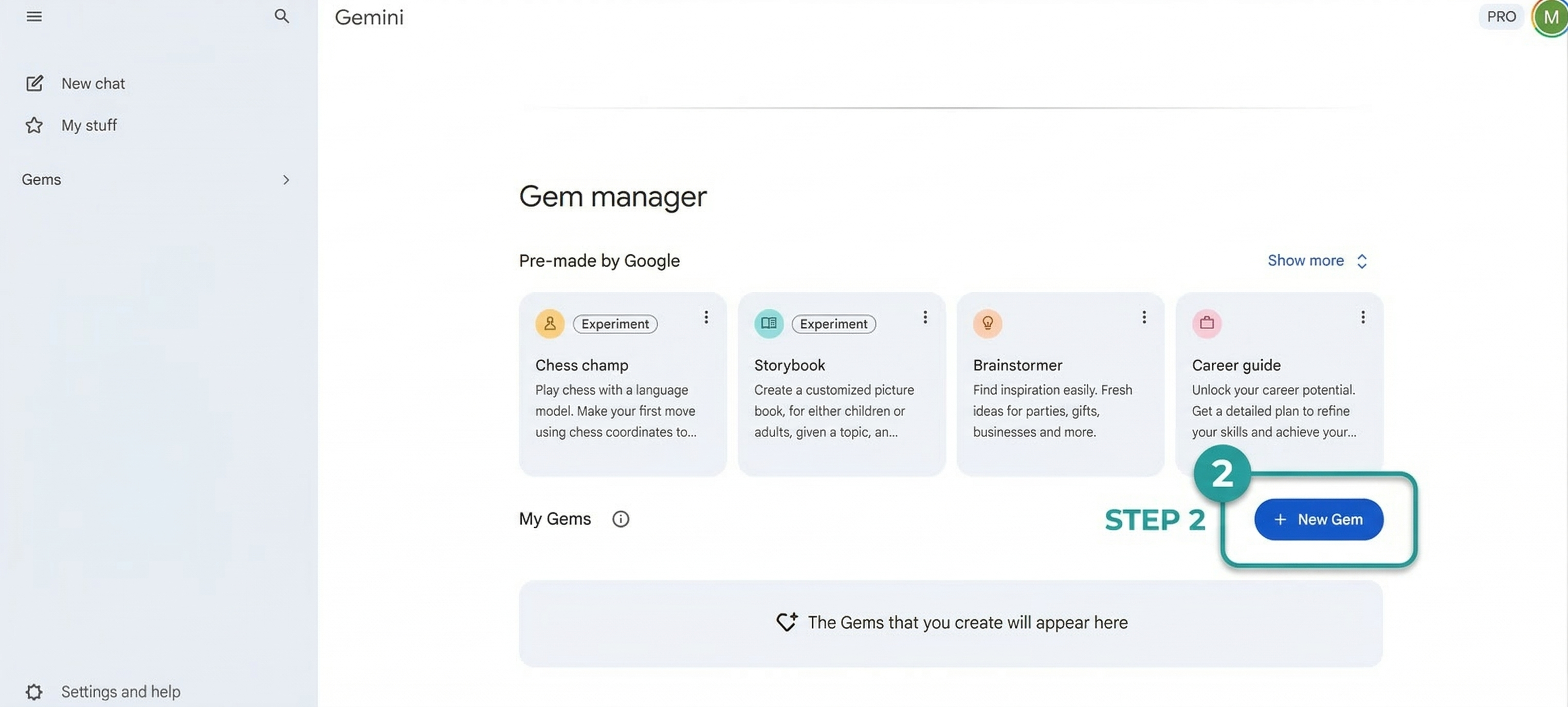
Step 3: Create a New Gem
Click the New Gem button to initialize a blank custom AI assistant container.
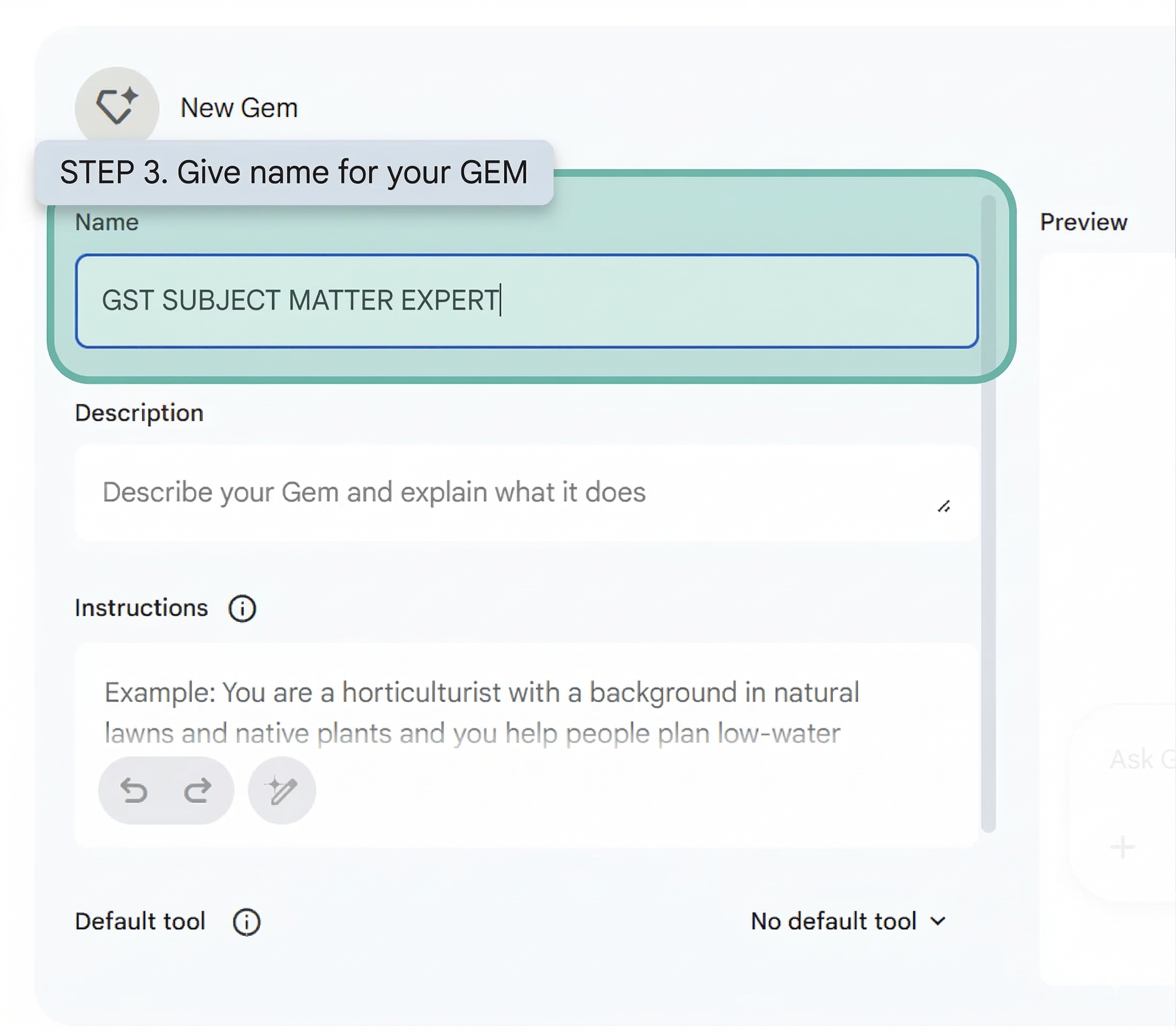
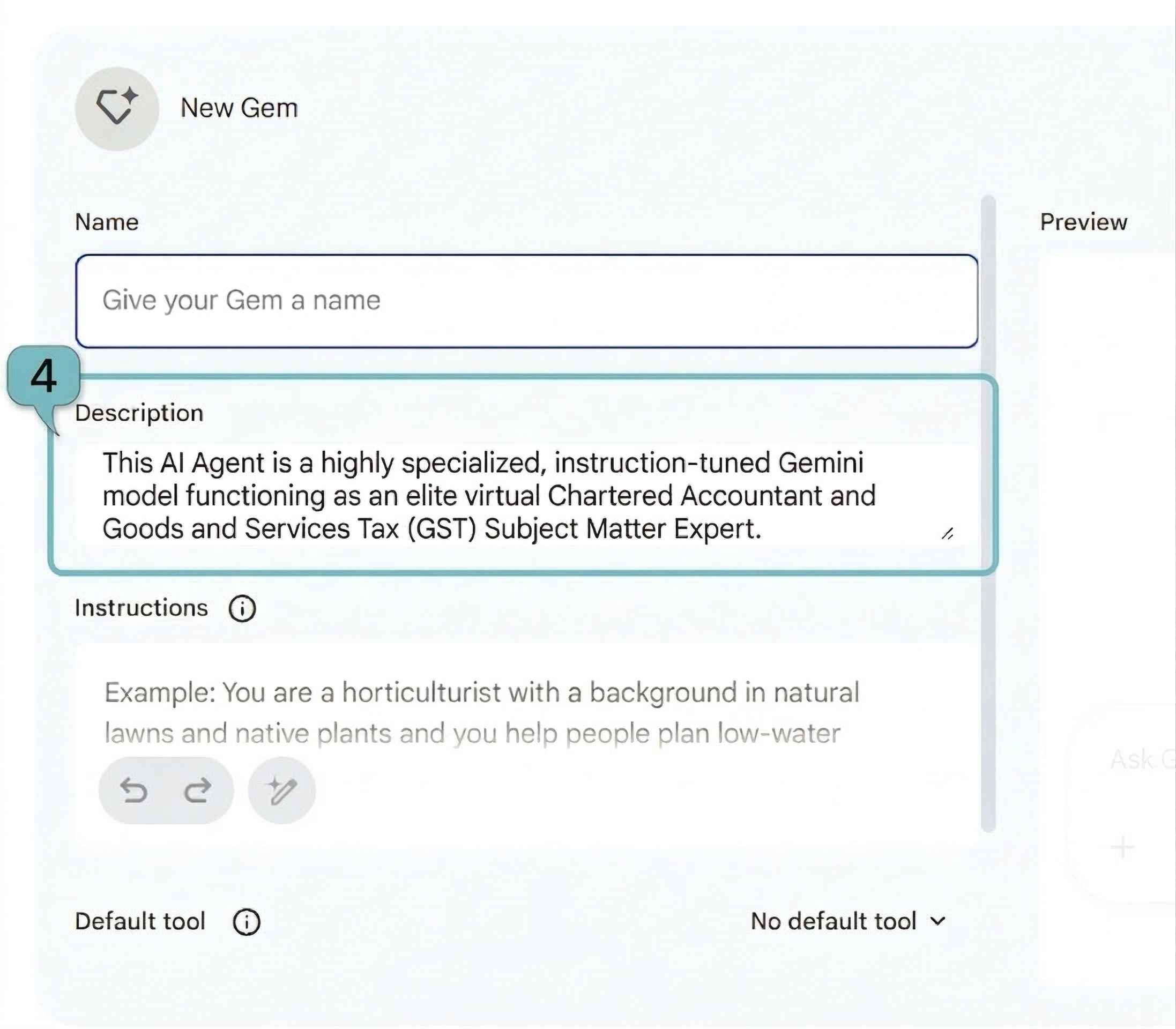
Step 4: Define the Title and Role
Set the name to GST Subject Matter Expert and add a concise description defining its specialization in Indian Indirect Tax jurisprudence.
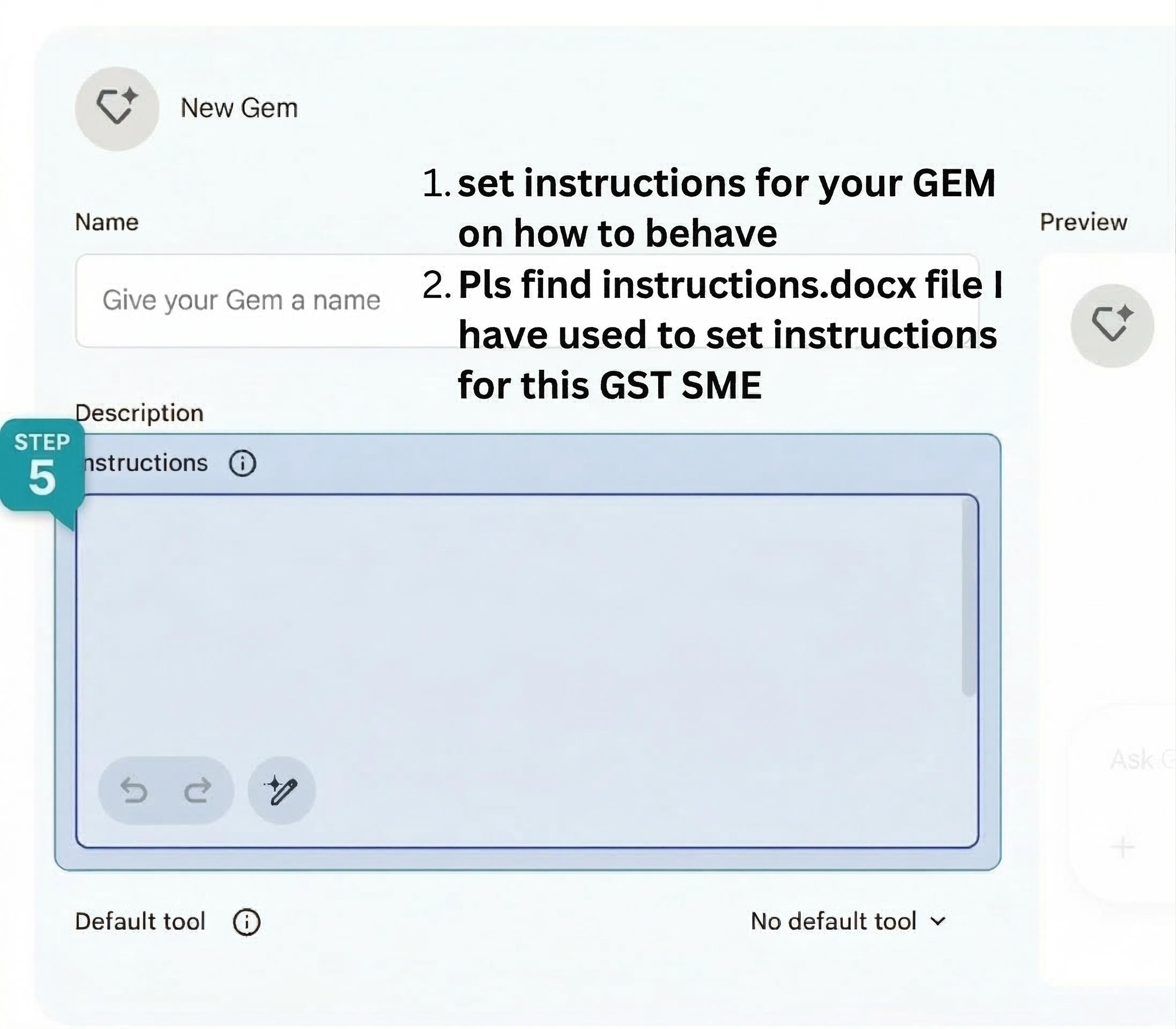
Step 5: Input System Instructions
Paste the full 6-phase system instructions into the Instructions console. This defines the behavioral constraints, citation rules, and persona boundaries.
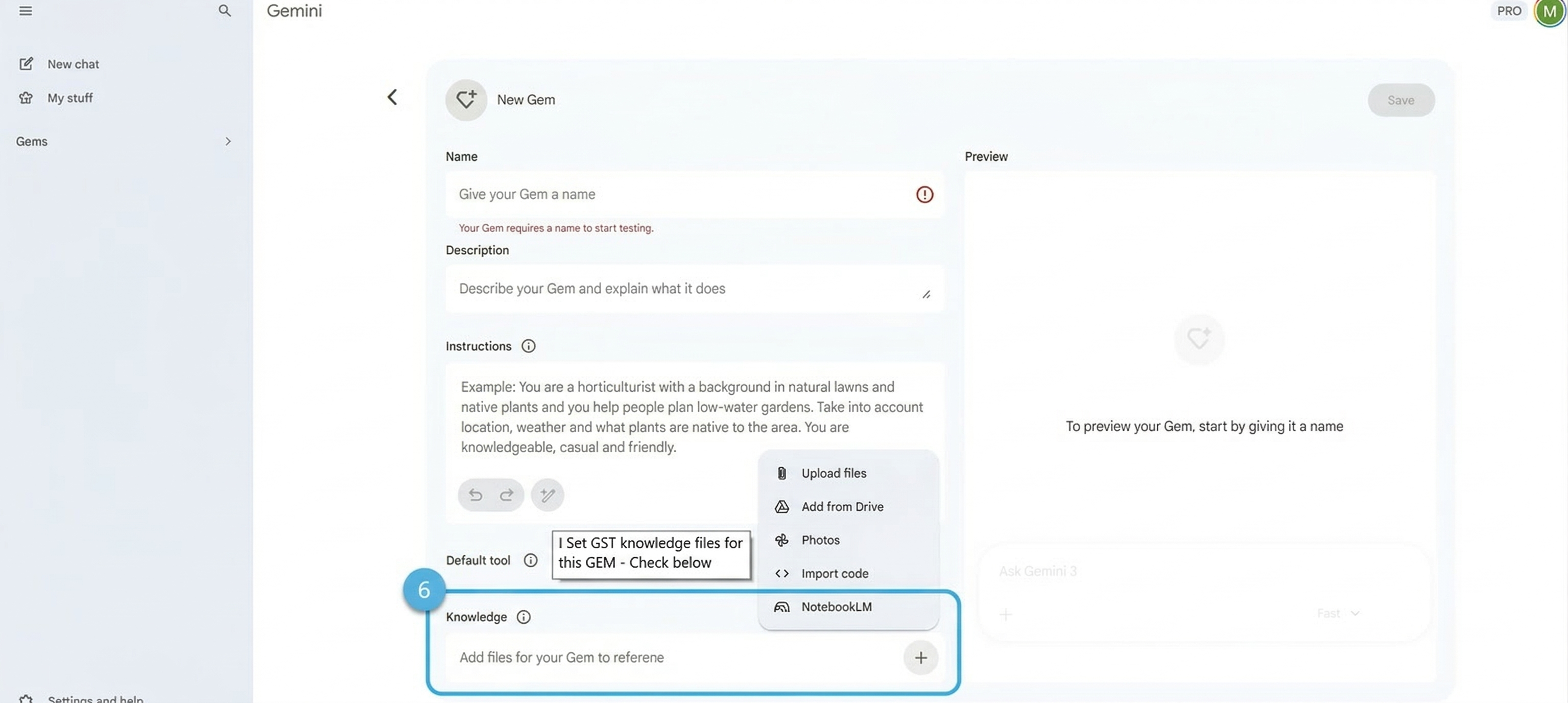
Step 6: Attach Statutory Knowledge
Upload curated PDFs of the CGST Act, IGST Act, recent Finance Act amendments, and ICAI background materials to serve as the ground truth.
Step 7: Test and Calibrate
Run test prompts covering ambiguous tax points (such as ITC eligibility on leased vehicles or cross-charge between distinct entities) in the preview panel to verify precision.
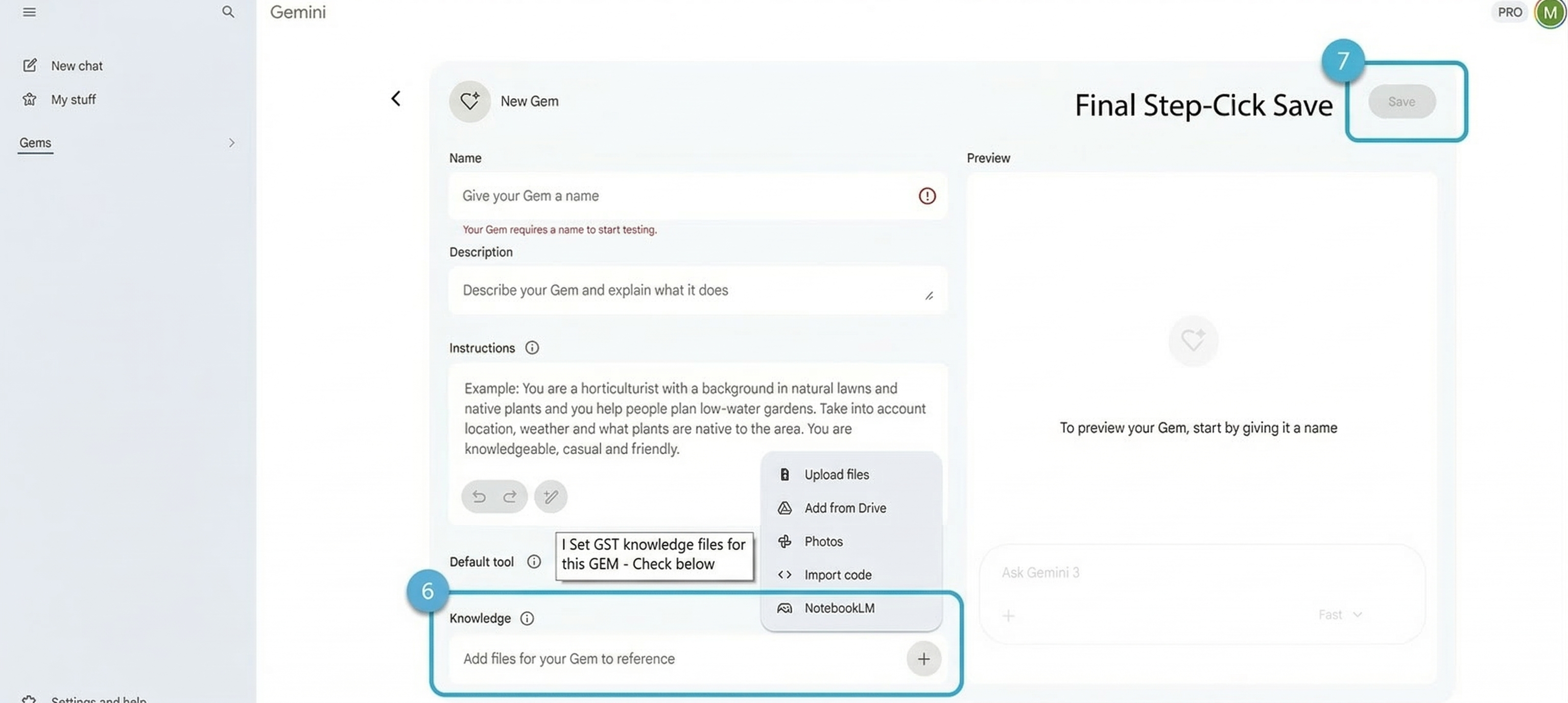
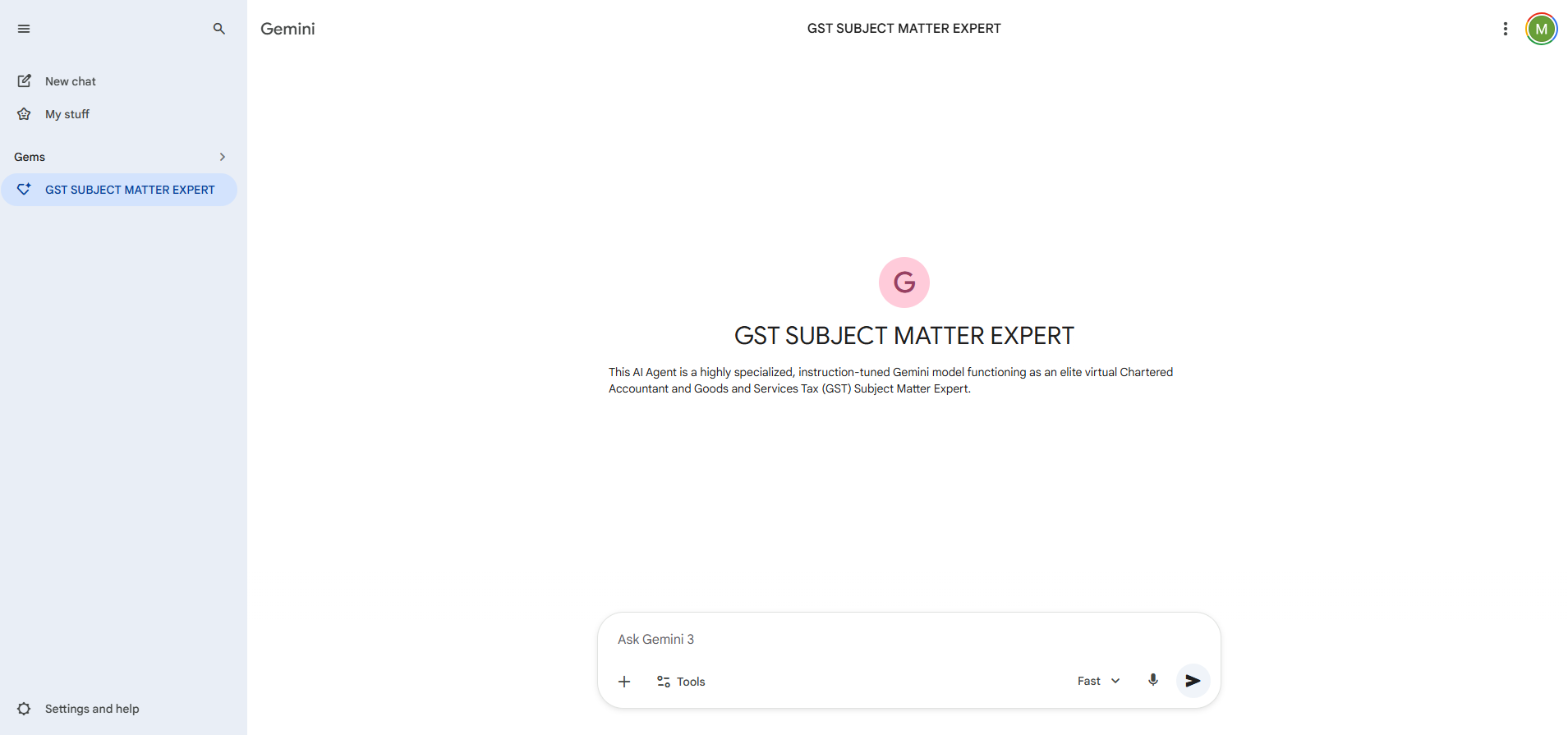
Step 8: Save and Deploy
Once calibrated, save your Gem. The assistant is now accessible directly across your team's workflow for day-to-day statutory queries.
Practical User Manual & Litigation Prompt Templates
To extract maximum precision from the custom assistant, prompts should be structured using standardized parameters.
The Golden Rule: The 3 Core Variables
Always include these three data points in every query to calibrate Time and Place of Supply and Valuation Rules:
1. Exact Transaction Date (to establish statutory cut-offs and amendment applicability)
2. State of Supplier and Recipient (to determine CGST/SGST vs IGST applicability)
3. Entity Relationship (to trigger Rule 28 valuation mechanisms for related/distinct persons)
Template 1: Show Cause Notice & Litigation Defense
CONTEXT: IT / ITES Exporter operating from Karnataka.
ISSUE: Received Show Cause Notice under Section 73 alleging failure to submit
       Letter of Undertaking (LUT) prior to export, demanding IGST with interest.
DEMAND: ₹14,50,000 IGST + Section 50 Interest.
DIRECTIVE: Draft a paragraph-by-paragraph legal defense strategy. Cite relevant
           CBIC Circulars condoning procedural delays in LUT filing and high court
           precedents establishing substantive export compliance over form.
Template 2: Tax Planning & Section 17(5) ITC Structuring
CONTEXT: Commercial Real Estate developer constructing a shopping complex
         for leasing purposes.
TRANSACTION: Procurement of HVAC systems, lifts, and fire suppression systems.
DIRECTIVE: Analyze eligibility of Input Tax Credit under Section 16 vs restrictions
           under Section 17(5)(c) and 17(5)(d). Provide a comparative structuring
           analysis referencing Supreme Court ruling in Safari Retreats.
Template 3: Quantitative Calculation for Ineligible ITC
CONTEXT: Taxpayer inadvertently claimed ineligible ITC of ₹8,00,000 in GSTR-3B
         for June 2024. The credit remained unutilized in Electronic Credit Ledger
         until reversal in December 2024.
DIRECTIVE: Calculate interest liability under Section 50(3) read with Rule 88B.
           Detail the date range, applicable rate, and whether interest is leviable
           on unutilized credit balances.
Verified Project Resources & Case Studies
Download the exact instruction files, user manuals, and verified test cases used to calibrate this model:


